Temporal laws
Forward, Looping and Branching Time, how each one changes the way machines connect, and how to build for each.
On this page
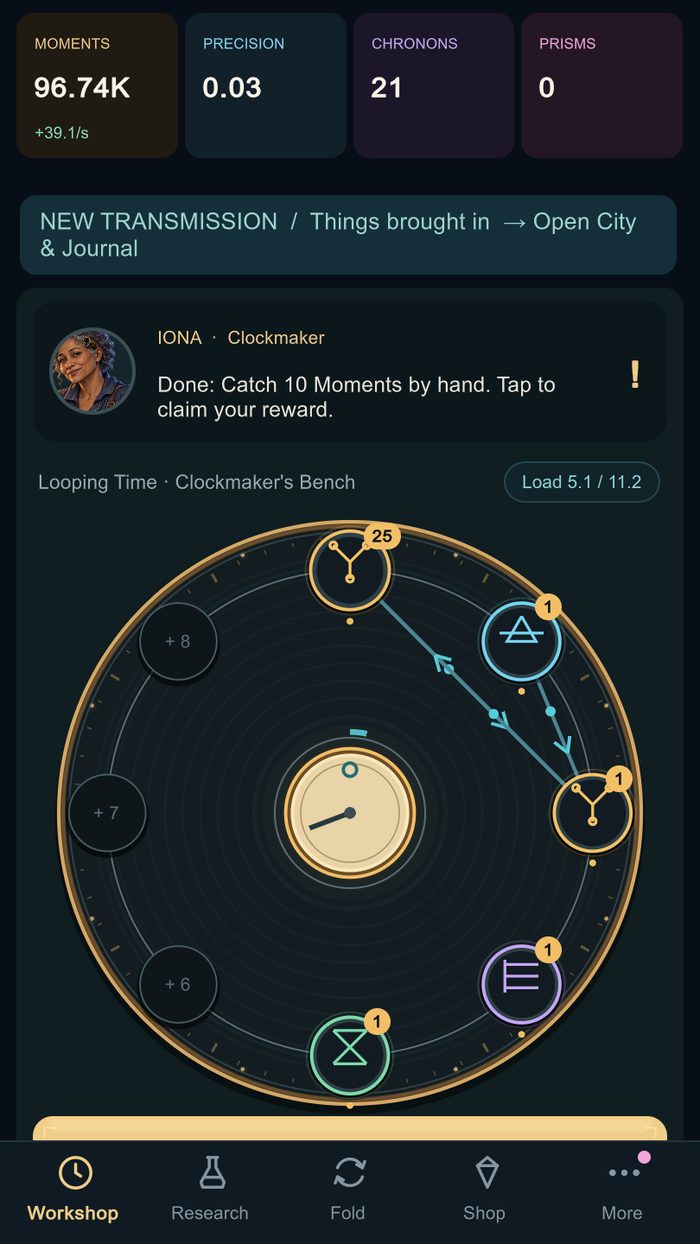
Every time you Fold, you choose the temporal law your next run follows. The law decides how routes behave and what kind of workshop is rewarded. Your current law and blueprint are shown above the ring, for example "Looping Time - Clockmaker's Bench".
| Law | Unlocks at | The idea |
|---|---|---|
| Forward Time | Start | Long clockwise chains. |
| Looping Time | 15 lifetime Chronons | Closed circuits that build resonance. |
| Branching Time | 60 lifetime Chronons | Two boards working in balance. |
The Fold you are about to take counts toward these totals, so the Fold screen tells you if a law will be available.
Forward Time
Routes must point forward: to a later socket clockwise, or out to an outer ring. Each Splitter feeding a machine gives it +8% output, up to +40% at five stages. The sender keeps its own output.
- Build one long clockwise chain of Splitters, then add Lenses and Reservoirs around it.
- Routes can never form a cycle.
Looping Time
Routes may go in any direction, so you can close a circuit. Machines in a closed circuit build resonance, rising towards +75% over a few minutes (the warm-up has a time constant of 90 seconds).
- Changing a circuit resets its resonance, so settle your layout first and leave it alone.
- Anchor machines keep part of the resonance when you change a loop. Combined retention is capped at 75%.
- Resonant memory research makes loops warm up 10% faster per rank.
Branching Time
Your workshop is split into two boards, Branch A and Branch B, each with its own Splitter, rings and load. Routes stay inside one branch, and there is no chain bonus in this law. Use routes for support machines.
The two boards earn a convergence bonus when their production is balanced, so the aim is to keep both boards strong and similar. Parallel thought research strengthens that bonus.
- Each board has its own capacity and its own load, so check both. A selector on the workshop switches between Branch A and Branch B.
Which should I pick?
- Learning the ropes: Forward Time, always.
- Interested in clever circuits: Looping Time, once available.
- Patient planners who enjoy balancing two boards: Branching Time.
Each law has its own matching challenge on the Experiment Board. See discoveries and experiments, and you can save a layout per law. Layouts only apply to the law they were saved under.
Tip: If a run feels stuck in one law, try a different one at your next Fold. Your Chronons, research and discoveries carry over, and only the way machines connect changes.