Gatekeepers and landmarks
The guardian on every floor's last cog, the landmark floors every ten, the great clocks and the story the tower tells.
On this page
Warning This page describes the story fragments and later parts of the tower. Skip it if you want to find them yourself.
The Gatekeeper
The last cog of every floor is held by a Gatekeeper. Compared with the Rust on the same floor's other cogs, a Gatekeeper:
- has five times the health of an ordinary cog on that floor (three times on floors 1 to 4, to be gentle with new players),
- strikes 50% harder,
- drops Gearshards, the currency for expeditions.
Beating it clears the floor. A swarm that falls to a Gatekeeper keeps the floor it reached; it tries again.
Landmark floors
Every tenth floor is a landmark. Its Gatekeeper leaves three Salvage finds (keep one; see Salvage), and the hive hears a story fragment. Landmarks are also where new parts of the game tend to open: floor 10 opens expeditions, floor 20 the Rewind.
Later Eras
After the Grand Winding, landmark Gatekeepers learn tricks. One new ability is added for each Era past the first, in this order:
| Ability | What the Gatekeeper does |
|---|---|
| Mending | Heals a little every second |
| Plated | Every strike does a quarter less |
| Twinned | Has twice the health |
| Furious | Strikes half as hard again once below half health |
The Rust itself also gets a new name in each Era: Tarnished, Gilt-rot, Glassbound, Starved. See The Grand Winding.
The great clocks
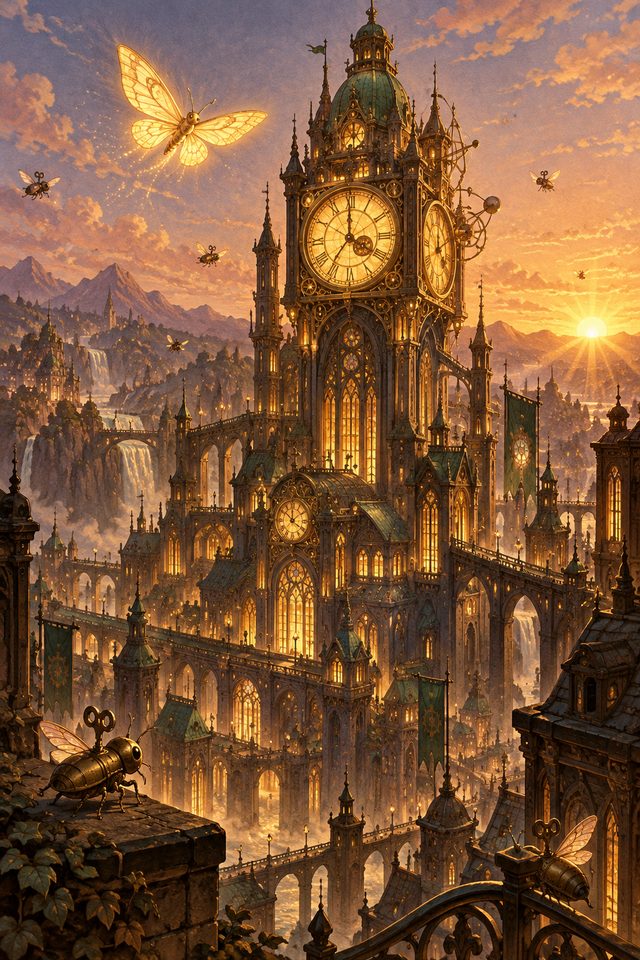
Every 100 floors, a great clock is restarted. The gears catch, the pendulum swings and bells ring down the whole tower, and warm light runs along every stair you have climbed. The moth flies into the light and comes back brighter, and each great clock strengthens the lantern moth. The tower does not end at the clock, and the climb continues above it.
The story so far
The tower's story is told in fragments, one on each landmark floor. They come in arcs of ten, one arc per great clock. Ten arcs are written, which carries the story to floor 1,000, and short echo lines cover the floors beyond.
Arc one, floors 10 to 100. A moth flies ahead of the swarm. On the wall, someone has made small neat tally marks in rows of twelve, with a tiny key beside each row. The marks stop halfway on floor 20, the last drawn very lightly, as if whoever made it meant to come back. Further up the hive finds an open workshop, a bell that has never been rung, a note folded under a step ("Thank you for coming up the stair"), a mural of brass insects and a moth of light, and Rust that pulls back from the ticking of the swarm. Around floor 90 a vast pendulum comes into view, hanging still in the dark far above, and the moth flies up towards it further than it has ever gone.
Arc two, 110 to 200. The wrights who built the tower: bunks made up neatly, one carved with the name Ottilie, a sealed letter addressed to "the keeper beyond the wall", Rust grown into silent flowers, a brass map of the tower that does not end, and a faint ticking from somewhere above that is not your own.
Arc three, 210 to 300. The ticking turns out to be another hive, smaller and older, that has kept itself going behind a barricade. The two hives meet with a careful hello and work side by side.
Arcs four to ten go on from there: weather that grows inside the tower, Ottilie's way, what the Rust remembers, the long winding, lights in the distance, the quiet floors and a thousand floors of light.
Note The game never explains the Rust.
Tips for the climb
- Take a break from fighting by running the chamber that holds your next pattern; see Equipment and expeditions.
- Pick Salvage that covers your weakness.
- Great clocks raise the moth's bonus, so floors 100, 200 and 300 give a small power-up as well as a story fragment.