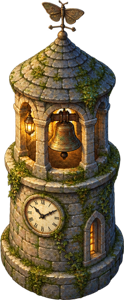
Towers at a glance
How towers, rarities, families, limits, levels, stars and final forms fit together in The Last Bell.
On this page
Towers are built with Parts during a run, and each one has a rarity, a family and its own way of working. This page covers the rules that apply to all of them. The pages for each rarity list every tower.
Rarities
| Rarity | Frame colour | Where to read about it |
|---|---|---|
| Common | stone grey | Common towers |
| Uncommon | verdigris | Uncommon towers |
| Rare | blue | Rare towers |
| Epic | violet | Epic towers (spoilers) |
| Legendary | gold | Legendary, Mythic and Exalted (spoilers) |
| Mythic | crimson | same page |
| Exalted | pale white-gold | same page |
Higher rarities are stronger and cost more Parts, but fewer of them may stand on the field at once. Every tower also has its own shape, so you don't have to rely on colour to tell rarity.
Field limits
| Rarity | At most on the field |
|---|---|
| Common and Uncommon | as many as you have pads |
| Rare | 4 |
| Epic | 2 |
| Legendary | 1 |
| Mythic | 1 |
| Exalted | 1 |
How towers unlock
Towers unlock by the best wave you have ever reached, in any run. You begin with the Clapper, Spring-gun and Chime post. Each other tower has its own wave. A few Trials unlock a tower early; see Trials.
Levels inside a run
Within a run a tower can be raised to level 10. Each level makes the tower strike harder (damage grows by about 45 percent a level) and reach a little further (about 3 percent), but each upgrade costs about 62 percent more than the last. Selling returns 70 percent.
Stars, forever
Separately, each tower has a permanent star rating, bought with Bell-metal in the Foundry. Each star makes that tower strike 25 percent harder in every later run, compounding, up to 15 stars. The first star costs 25 Bell-metal for a Common tower, and more for higher rarities (40, 65, 100, 150, 225 and 300 for Uncommon through Exalted). Each further star costs about 45 percent more than the last.
Final forms
At level 10, each tower chooses one of two final forms, each with its own painting. For example, the Spring-gun becomes a Repeater (fires twice as fast) or a Harpoon (each bolt pierces up to three wind-ups in a line). The choice lasts for that tower in that run, so you can choose differently next time. Every form is listed on the rarity pages.
Families
Every tower belongs to one of seven families: Bell, Spring, Weight, Air, Light, Oil and Time. Families matter for a few things.
- Fliers: Spring, Bell and Air towers can generally strike fliers (Gliders); Weight and Oil towers cannot. Each tower's card says so, and so do the pages here.
- Pairings: some towers reward being used together. See Tower pairings.
- The moth prefers to settle near Light towers. See The lantern moth.
Reach
Reach is measured in tiles of the field, which is 11 tiles across. Fog and some Trials shorten reach for every tower. Lantern posts and similar towers lengthen it for their neighbours.
Tip One kind of tower won't cover everything. Armour, fliers, healers and umbrellas each need a different counter, and The wind-ups lists them.